Many people associate the summer season with sunshine, freedom and relaxation, but due to the extreme weather conditions of recent years, it is increasingly necessary to prepare for sudden, large amounts of precipitation. An intense summer thunderstorm can pour such a volume of water onto a property in a few minutes that it can cause serious damage to the basement, garage or even the foundation of the building.
Many people only encounter the problem when there is standing water in the basement, stored valuables are damaged, or expensive repairs are required. for unclogging and restoration is needed. Yet, with a few simple checks, this can often be prevented.
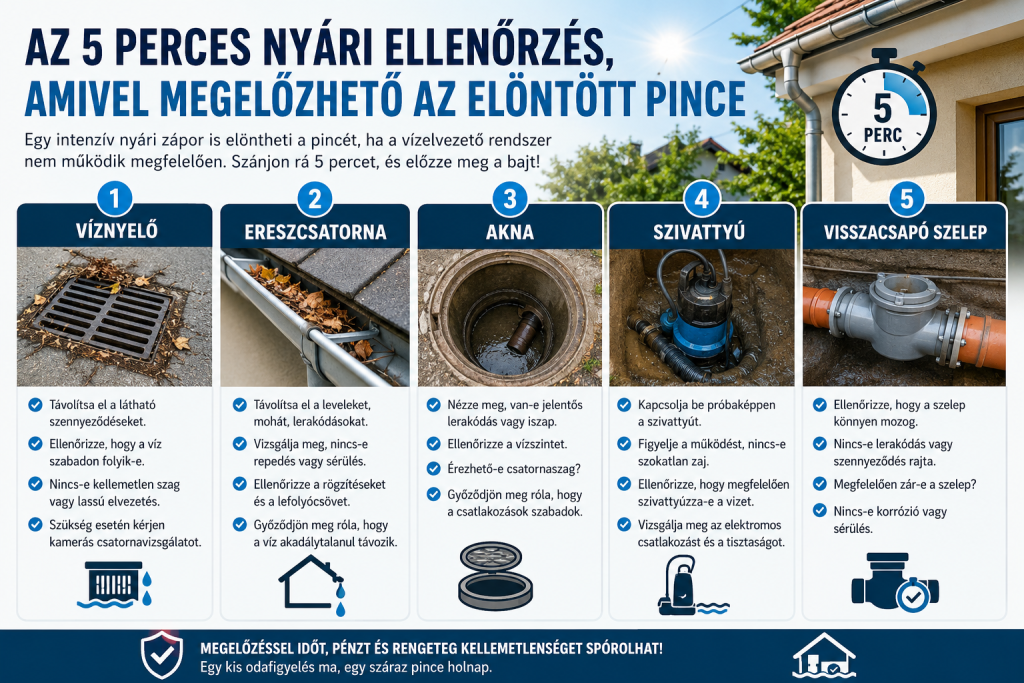
The following 5-minute summer checklist can significantly reduce the risk of flooding.
1. Check the drains
The purpose of gutters is to drain rainwater quickly and easily. However, if leaves, mud, dust, gravel or other debris collect in them, the water cannot drain properly.
It is especially common in the summer to get branches, leaves and other debris into drains after storms. Even a partial blockage can be enough to cause water to back up and appear in places where it shouldn't.
Checklist:
- Remove visible dirt.
- Check to see if water is flowing freely around the sink.
- Check for any unpleasant odors or slow drainage.
- If necessary, ask a professional to perform a camera sewer inspection.
2. Check the gutters
The condition of your gutters has a direct impact on the drainage of your building. A clogged or damaged gutter will cause rainwater to flow away from your home, instead of draining into the walls, around the foundation, or even directly into your basement.
It's worth taking a few minutes to check your gutters before summer storms.
What should you pay attention to?
- Are there leaves, moss or other deposits in it?
- Are there any visible cracks or damage?
- Are the supports properly secured?
- Is the drain pipe free to pass through?
The gutter is regular cleaning can significantly reduce the risk of basement flooding and water accumulation around the foundation.
3. Check the mines
Stormwater and wastewater culverts often go unnoticed, even though they play a key role in drainage. Over time, culverts can accumulate silt, sand, roots, or other deposits that can prevent the system from functioning properly.
A quick check is worth checking:
- Is there significant sediment in the well?
- Is there a constant rise in water levels?
- Can you smell a sewer smell?
- Are the connecting wires freely accessible?
If there is an unusual amount of water or dirt in the sump, it is advisable to seek professional help as soon as possible.
4. Test the pump
Regular inspections are especially important for properties with basement pumps or sump pumps. Many owners only encounter problems when the device is supposed to be working.
It's worth doing a test run for a few minutes before summer thunderstorms.
Check:
- Does the pump turn on properly?.
- Is there any unusual noise during operation?.
- Does it remove water at an adequate rate?.
- Are there any blockages or deposits in the system?.
- Is the electrical connection in good condition?.
A faulty pump can cause damage worth hundreds of thousands of forints during a single heavy rain.
5. Inspect the check valve
A check valve is one of the most important protective elements in a property's sewer system. Its function is to prevent sewage or rainwater from flowing back into the building.
During heavy rains, the public sewer can become overloaded. In such cases, due to the lack or malfunction of the check valve, water can even back up through the basement drains.
During inspection, pay attention to:
- The valve should move easily.
- There should be no deposits on it.
- Close properly.
- Show no signs of corrosion or damage.
The regular maintenance significantly increases the life and reliability of the valve.
Why is it worth performing this check several times a year?
Most basement leaks are not the result of a sudden problem. They are often caused by months or even years of accumulated dirt, minor defects, and missed maintenance.
A 5-minute inspection can help you identify potential hazards in time, prevent sewer system failure, and avoid costly restoration work.
Summer storms are becoming more intense, so regularly checking your gutters, downspouts, sumps, pumps, and check valves is no longer a luxury, but a basic precaution. A little attention is often enough to avoid a flooded basement after the next heavy rain.
Prevention is always cheaper than repair. If you are experiencing slow drainage, recurring blockages, unpleasant odors or sewer system problems, contact us with confidence to our experts. For more useful advice and quick help, visit our website!